Layout / mesh input
Import an existing mesh, or begin from GDS/layout information for MEMS workflows.

Technology
From layout and mesh input to physical-model foundations, Zenoriq builds the technical bridge between nonlinear simulation models, structured insight records, and engineering decisions.
layout · mesh · technology stack
geometry · materials · domains · actuation
Technology philosophy
Zenoriq is not positioned as a FEM replacement. FEM remains part of the physical foundation. Zenoriq adds the nonlinear insight layer that turns model structure into engineering decisions.
Input foundation
Zenoriq can start from an existing mesh/FEM model, or from GDS/layout data combined with a technology stack to generate the device geometry and mesh foundation.
Layer definitions, materials, thicknesses, conductors, domains, boundaries, and actuation information become the physical foundation for the structured nonlinear insight model.
Import an existing mesh, or begin from GDS/layout information for MEMS workflows.
Connect layers, materials, thicknesses, conductors, and domains to the physical setup.
Generate or import the geometry and mesh used to build the nonlinear insight model.
Workflow
Zenoriq connects layout, mesh, technology-stack, and physical-model information into one structured path from device definition to nonlinear engineering insight.
Core principle
Instead of relying on dense response sampling or repeated full-order studies, Zenoriq builds a structured model from the physical system. Once extracted, the model can be queried directly for nonlinear behavior, relationships, and decision-relevant records.
Common route
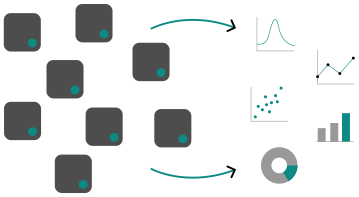
Many workflows depend on dense sweeps or repeated full-order studies before nonlinear trends become visible.
Zenoriq route
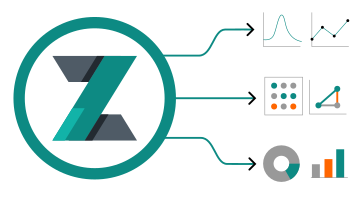
A structured model preserves the relationships needed to evaluate behavior, coupling paths, root causes, and device KPIs directly.
Outcome
The structure turns nonlinear model information into decision-ready records instead of isolated plots.
Zenoriq Engine · Compute
Zenoriq Engine is the backend layer for automated computation. It prepares structured nonlinear insight models, evaluates operating states, generates linked records, and supports batch-oriented analysis without repeating full-order studies for every question.
Zenoriq Atlas · Discover
Zenoriq Atlas is the interactive discovery environment. It is where computed records become maps, graphs, rankings, operating-window views, and geometry-linked explanations.
Insight records
Each insight record carries scope, provenance, related operating states, linked observables, coupling paths, attribution results, and device-aware KPI meaning. This is what turns model output into reusable engineering knowledge.
Where the device remains usable, stable, and inside configured engineering limits.
Which mode, coefficient, domain, conductor, or region dominates a KPI.
How modes, domains, signals, and observables interact.
Engineering metrics such as scale factor, scan angle, purity, gap margin, or operating range.
Electrical and mechanical signals linked to modal and geometric behavior.
Validity, robustness, and confidence checks for reduced-model interpretation.
Engineering questions
One structured model can support operating-point analysis, bias exploration, coupling analysis, observable evaluation, KPI extraction, attribution, and design comparison. The goal is not one isolated result, but many connected engineering questions from one traceable foundation.
Attribution
A target KPI can be traced back through the dominant coupling path, involved modes and domains, relevant conductors or regions, and finally to the engineering decision it supports.
Why it matters
Built from the underlying physical model instead of relying on extensive response sampling.
The nonlinear model keeps the relationships needed to trace behavior back to modes, domains, regions, and device functions.
KPIs, coupling paths, and root-cause indicators can be evaluated directly from the model structure.